Staphylococcal enterotoxin B (SEB)
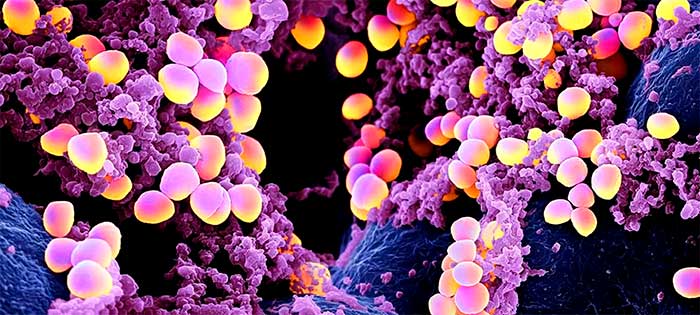
A colorized electron microscope image captures a Staphylococcus aureus bacteria colony.
Code Names and Military Designations: Agent PG, Staphylococcal enterotoxin B, SEB, SE, PG, PG2, UC.
General Characteristics. Staphylococcal enterotoxin B (SEB) is one of seven exotoxins produced by the bacterium Staphylococcus aureus. It consists of 239 amino acid residues and has a molecular weight of 28 kDa. SEB belongs to the enterotoxins and causes symptoms of acute enterocolitis in humans. It is a frequent culprit of common food poisoning involving spoiled meat and dairy products.
Once inside the body, the staphylococcal enterotoxin acts as a superantigen. Unlike normal antigens, which activate only a tiny fraction of T-cells (0.01%), a superantigen can bypass the normal immune response and trigger up to 20% of the body's T-lymphocytes simultaneously. This massive activation results in a "cytokine storm"—an explosive release of inflammatory mediators such as interleukin-6, γ-interferon, and tumor necrosis factor. This overwhelming systemic response, rather than the direct action of the toxin itself, leads to the characteristic symptoms of intoxication and, in severe cases, can trigger septic shock. [4]
Physicochemical Properties. Purified SEB is a snow-white hygroscopic powder, highly soluble in water. SEB is relatively resistant to environmental factors and does not lose its toxicity even when boiled for half an hour. Aqueous solutions with a pH of 4–10 are quite stable at room temperature. Lyophilized powder can be stored for more than a year at 4°C. On soil, it breaks down in less than two hours.[29]
The resistance of SEB to environmental factors could theoretically be used to create hybrid toxins with new, unusual characteristics. For instance, the work of J.B. Tucker and C. Hooper (2006) discusses the possibility of using genetic engineering to create a new toxin that combines the stability of SEB with the high lethality of botulinum toxin.[23]
The presence of SEB aerosol in the air is very difficult to detect, as it is colorless and odorless; therefore, SEB was considered one of the most suitable non-lethal standard chemical warfare agents for covert application.[19]
History of Development and Application
Long before SEB was officially weaponized in the early 1960s, it was used by U.S. intelligence services to support sabotage operations that required short-term neutralization of the enemy, lasting up to several days. To incapacitate a person for a longer period, the American intelligence arsenal included Venezuelan Equine Encephalitis (VEE) and Brucellosis.
Stanley Lovell, who headed the Research and Development branch of the Office of Strategic Services (OSS) during World War II, mentions in his memoirs an instance where SEB was used to incapacitate and prevent the attendance of German Reich Minister Hjalmar Schacht—considered Hitler's personal banker—at an important economic conference.[3,10]
In 1942, on the eve of the Allied landings in North Africa, the American station in Casablanca needed to neutralize a German agent for several hours. The objective was critical: to prevent him from transmitting intelligence regarding the imminent Anglo-American invasion. Turning to specialists at Fort Detrick for a solution, they were provided with SEB from the facility's available stocks. During the operation, an American operative managed to surreptitiously lace the oysters ordered by the German with the toxin. Following the operation's success, General Porter, head of the Chemical Warfare Service, noted: “The staphylococcus worked like a charm.” The German spy had been neutralized.[16]
During the Cuban Missile Crisis in October 1962, the U.S. considered the possibility of using a cocktail of Staphylococcal enterotoxin (SEB) and Venezuelan Equine Encephalitis virus (VEE) during an invasion operation of Cuba.[12]
In 1969, at the U.S. Army Biological Center in Fort Detrick (Maryland), tests were conducted on primates using a combination of SEB and the causative agent of tularemia (Francisella tularensis).[24]
Production. 150-liter industrial fermenters were used for the production of SEB.[29] During the cultivation of strain 10-275, the yield of SEB was 0.5 grams of toxin per 1 liter of culture medium.[15] The live culture growth cycle lasted 10 hours. Industrial production capacities for SEB in Pine Bluff (Arkansas) allowed for the production of up to 272 kg of dry form per month—twice the amount of botulinum toxin the U.S. could produce.[13]
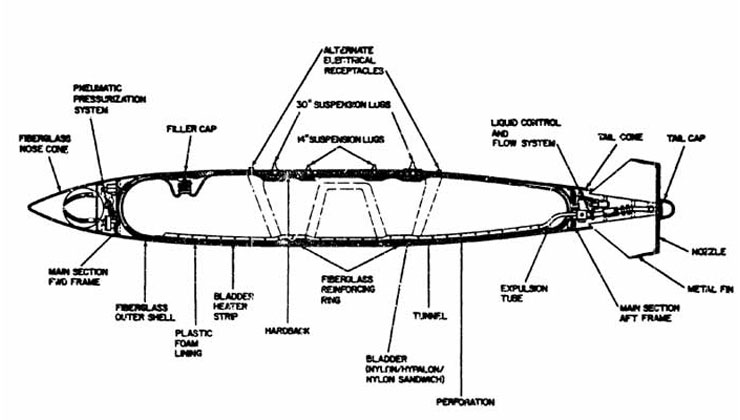 The A/B 45Y-4 aircraft aerosol sprayer is capable of dispersing more than 100 kg of dry SEB into the atmosphere |
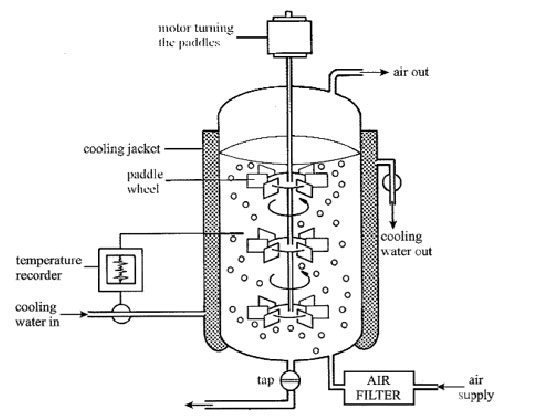 Diagram of a standard industrial fermenter |
In 1968, during U.S. Air Force combat exercises over Eniwetok Atoll (Marshall Islands), 95 kg of SEB aerosol was sprayed over an area of 2,400 square kilometers. To evaluate effectiveness, laboratory animals, including monkeys, were placed on ships. As a result of the tests, 30% of the animals were affected.[13]
SEB received high praise from the U.S. Army and government. In a 1970 Report to the National Security Council, it was noted that "No synthetic chemical incapacitant appears to have equally promising characteristics and no other incapacitant in R&D has been operationally tested to date."[13]
In 1969, President R. Nixon called for the abandonment of the development and production of biological weapons in favor of nuclear weapons. In a conversation with his speechwriter, he explained it this way: “We'll never use the damn germs, so what good is biological warfare as a deterrent? ...If somebody uses germs on us, we'll nuke 'em.”[25] By 1972, all stockpiles of biological weapons in the U.S., including SEB, had been destroyed.
France. Between 1962 and 1964, research into the aerosol form of SEB as a potential offensive biological weapon was conducted in France at the "Laboratoire Militaire de Recherches Vétérinaires" (LMRV). In addition to SEB, work was also carried out here with other non-lethal biological agents.[14]
USSR. Studies on the staphylococcal toxin were conducted at the Military-Biological Institute Zagorsk-6 (military unit 44026) under the leadership of General A. A. Vorobyov, but it was never officially adopted into the arsenal.[11]
Iraq. There was little interest in SEB in Iraq, as they preferred more lethal microorganisms; therefore, the final choice was made in favor of the clostridial toxin of gas gangrene (Clostridium perfringens).
Bioterrorism. The use of toxins such as SEB in aerosol form for military or sabotage purposes is a complex technical task, on which the world's leading powers have spent hundreds of millions of dollars. These technologies remains inaccessible even to terrorist organizations with vast financial resources. This is evidenced by the failed attempt of the Japanese cult Aum Shinrikyo to assassinate Prince Naruhito using a botulinum toxin aerosol in 1993. In total, Aum Shinrikyo carried out 10 biological attacks using botulinum toxin and anthrax spores, all of which ended in complete failure.[27] The use of SEB to contaminate water supplies is also practically impossible due to modern multi-stage purification and disinfection systems for drinking water.
Delivery Systems
Most of the SEB delivery and dispersal systems described below were developed in the 1960s, and some were experimental prototypes.
- Disseminator, dry agent, E41R2. A disperser that used carbon dioxide as a propellant. It was purchased in limited quantities by the U.S. Army in 1964.
- Spray Tank TMU-38/A.
- Spray Tank A/B 45Y-4. Under development in 1966.
- The use of SEB in cluster bombs, tactical surface-to-surface missile warheads, and other types of weaponry was not ruled out.[20]
- Sabotage delivery means, such as the M4 and M5 special equipment or other "Big Five" special munitions.
M1 Biodart (E1): A .30-06 small arms round that delivers a toxin-coated projectile, using either saxitoxin (TZ) or botulinum toxin (XR), for the surreptitious elimination of a guard or sentry. At the time of destruction, 4,450 filled and 5,315 unfilled M1s were in the arsenal.
M2 Munition (E2): A 7.62 mm rifle shell that upon impact produced a small aerosol cloud of agent, containing dry botulinum toxin type A (XR) or Bacillus anthracis spores (TR2). When such a bullet burst, a small aerosol cloud was formed. In total, more than 70,000 such cartridges were manufactured.
M4 Disseminator (E41): Designed for the dispersal of the dry form of Francisella tularensis (ZZ) or dry Bacillus anthracis (TR2), operating on compressed gas. At the time of elimination, 21,000 filled and 34,568 unfilled M4s were stored in the arsenal.
M5 Depositor (E44): A road depositor to spread a layer of finely divided powder across a road (the material later gets resuspended as marching troops or convoys pass over it). Although designed for anthrax (TR2), all 90 existing units were filled only with simulants. A total of 2,604 M5 devices were in storage.
M32 Aerosol Generator (E32): A backpack-type generator. It consisted of an exchangeable reservoir, a compressed gas cylinder, a pressure regulator, and a timer. It could be loaded with either dry (2.5 kg) or liquid (7 liters) formulations. Before application, it was set up on the windward side of the target. It was intended for use with Francisella tularensis (ZZ) or Bacillus anthracis (TR2). At the time of elimination, 168 filled and 348 unfilled devices were available.[22,34]
SEB Toxicity via Various Routes of Exposure
According to SIPRI (1973) data, the median incapacitating concentration for aerosol inhalation (ICt50) is 0.5 mg·min/m3, which is 400 times lower than the median lethal concentration (LCt50) of 200 mg·min/m3.[20] According to other data, for parenteral administration, the lethal dose is only 50 times higher than the incapacitating dose: ID50 — 0.0004 μg/kg and LD50 — 0.02 μg/kg, respectively.[4] Mortality from SEB exposure does not exceed 5%. In severe cases, death occurs from pulmonary edema.[1] This level of toxicity does not meet modern requirements for incapacitating biological weapons.
In experiments on volunteers, oral ingestion of SEB at a dose of 0.02–0.025 mg caused vomiting and diarrhea after a 2–5 hour delay.[20] In 1967, scientists from the Pugwash Biological Group calculated that to cause mass poisoning, it would be sufficient to drink half a glass of water from a 5,000-ton reservoir to which 0.5 kg of Salmonella toxin, 5 kg of botulinum toxin, or 7 kg of SEB had been added.[18] These data likely did not account for the chlorination of drinking water, which significantly reduces the effectiveness of such sabotage methods using toxins.
The incapacitating dose (ED50) for ocular exposure is estimated at 0.002 mg, and for skin application, it is 0.84 mg.[5]
Clinical Presentation of Poisoning
Food Poisoning. The clinical presentation of poisoning depends on the toxin's route of entry into the body. When ingested with food, SEB causes nausea, repeated vomiting, spastic abdominal pain without clear localization, frequent watery stools, and general weakness. The loss of fluid through diarrhea and vomiting can cause dehydration. Fever is noted in only a quarter of cases. Cardiovascular symptoms include tachycardia and hypotension. Recovery typically occurs within 24 hours.
Inhalation Exposure. The main manifestations of intoxication during inhalation exposure are respiratory system disorders and general toxic syndrome. 3–4 hours after inhaling the aerosol, a person develops a severe, exhausting cough accompanied by intense dyspnea (shortness of breath) that worsens when lying down. Very often, dyspnea is accompanied by chest pain. Poisoning is accompanied by severe chills, headache, and muscle pain. Body temperature can rise as high as 41°C. In inhalation exposure, gastrointestinal symptoms are significantly milder than in food poisoning. Most victims reported nausea and loss of appetite, and short-term vomiting was observed in only half of the cases. None of the victims experienced diarrhea. Recovery usually occurs within 3–4 days, though the cough may persist for up to 4 weeks. Exposure to high concentrations of SEB can lead to the development of septic shock and acute respiratory distress syndrome.[4,8]
SEB is capable of penetrating intact epithelium.[7] If SEB aerosol enters the eyes, conjunctivitis develops, accompanied by inflammation of the eyelids and, in some cases, gastrointestinal disturbances.[5]
Treatment of Exposure
Symptomatic therapy is recommended. In cases of inhalation exposure, use humidified oxygen, dextromethorphan and codeine to suppress the cough reflex, paracetamol for myalgia and hyperthermia, and prochlorperazine and diphenhydramine for vomiting. The use of antifibrotic drugs, such as Pirfenidone, may prove promising. In the event of acute respiratory distress syndrome or pulmonary edema, the use of steroids is not recommended.[6]
Work on creating an anti-staphylococcal vaccine has been ongoing in the U.S. since the early 1960s, but to date, no commercial versions have been released.
Decontamination
SEB is a water-soluble protein and is therefore easily removed from the body, clothing, and surfaces using conventional detergents.
Detection
The toxin is detected using enzyme-linked immunosorbent assay (ELISA), chemiluminescence (CL), polymerase chain reaction (PCR), and other more modern methods.
For field detection of SEB, the U.S. developed the Man-portable Analyte Identification System (MANTIS)—a fully automated system based on an fiber-optic biosensor capable of accurately detecting the presence of SEB in samples starting at concentrations of 5 ng/ml.[30] A further development in this field was the Rapid Automatic and Portable Fluorometer Assay System (RAPTOR) biosensor analyzer, with sensitivity increased to 1 ng/ml and a detection speed of 3–10 minutes.[31] However, even this level of sensitivity may be insufficient, as cases of poisoning have been described with SEA content in products at concentrations of approximately 0.5 ng/ml.[32]
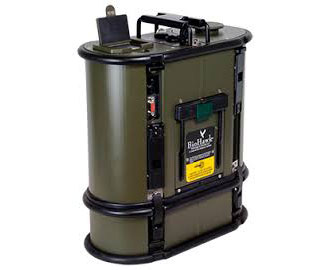
8-channel bioanalysis system
BioHawk©
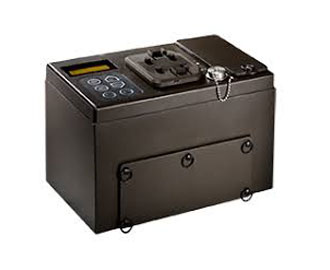
Portable automatic biosensor
RAPTOR©
One of the most advanced models available today is the BioHawk©, designed for monitoring aerosols of biological agents, toxins, explosives, and chemical contaminants; it is capable of detecting SEB at concentrations of 0.1–0.5 ng/ml. The result is available within 10–20 minutes.[33]
More modern diagnostic trends have shifted towards Next-Generation Sequencing (NGS) for strain identification and Matrix-Assisted Laser Desorption/Ionization (MALDI-TOF) mass spectrometry. These methods allow for the rapid identification of the toxin’s protein fingerprint even in complex environmental samples with minimal preparation.